Friday, 10 June 2016

Oh Senegal

Look out behind!!
This year the IT conference was held in Dakar Senegal, you know the place where the Paris to Dakar rally used to finish. Unfortunately the route from Paris to Dakar has become a little too dangerous, so while the contest is still known as the Dakar, it has nothing to do with Senegal.

Because of the way working weeks work I left Muscat on the Saturday, giving me Sunday to Tuesday in Senegal before the conference began. Col Yahya and Lt Mohammad made similar decisions.


Senegalese Customs Post at The Gambia border
Check out the load


On Sunday Mohammad and I went to the Sandaga markets and the statue of the African Renaissance. Interesting.  Before leaving for Senegal Katrina told me to buy some of the locally wax dyed fabric, so I did.Mohammad decided that his wife would also like some fabric, so shopped as well.  After we'd finished shopping we continued through the market and that's where we got one of the interesting Senegal experiences.  A stall holder invited me in,  I said "No", he invited again and offered his business card, once again I said "No, I've finished shopping".  Welllllllllll that led to the guy following us down the main road of the market calling me (at the top of his voice) racist. I put up with that for a little while before rounding on him and giving him both barrels. After that he settled down and became quite chatty, accompanying us for a few hundred meters and being quite friendly. At the end he told Mohammad "your friend has a big personality". I think that by calling his marketting strategy he became curious and was just happy to chat. BJ, he bargained down for your Senegal cap!
Monday we made a trip up country to the Fathala Safari Park and a night of "glamping"

Statue of the African Renaissance, bigger than Lady Liberty and built under
guidance of North Korea, the view from inside the man's head is spectacular


A Baobab tree, by no means a big one!
Fathala was 250 kms from Dakar and so a chance to see how the majority of Senegalese lived. Intriguing and interesting.  Mohammad had arranged a driver for us, and as much as the driving was relatively easy I would not have chosen to drive
myself. Interesting to see that most Senegalese live  in thatch roofed houses and that money is probably not a real issue in most of their lives. Houses were inside walled enclosures, with thatched roofs providing weather protection. Didn't see any sign of electrical power, but everybody seemed to have a charged mobile phone.

Giraffe in hot pursuit of the safari vehicle

Hmmm


Monkeying around at the watering hole
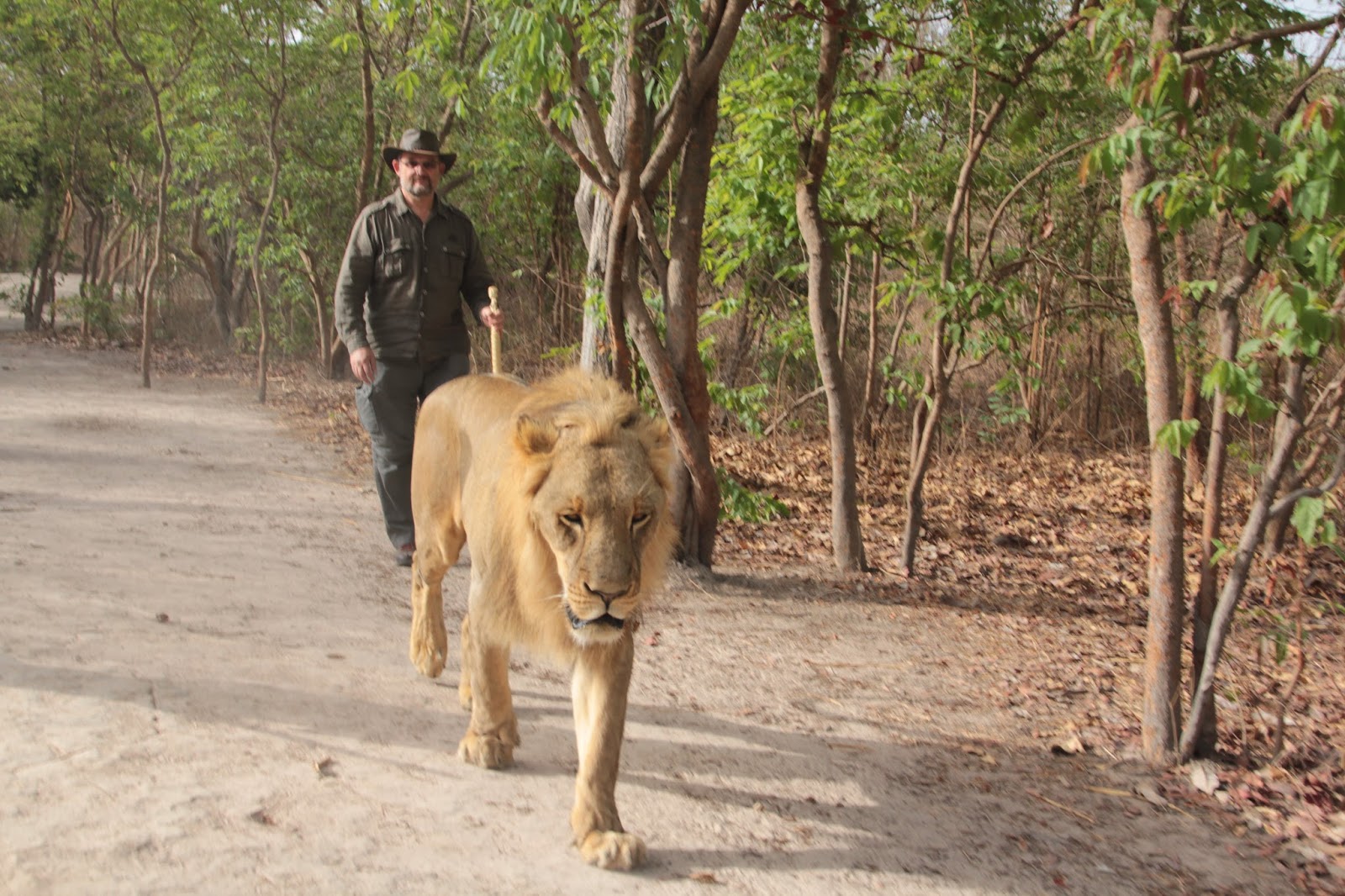
Anyway, approaching mid afternoon we got to Fathala and ran into Nestor, a South American in Senegal for the same conference and went on the same safari around the wildlife park. Lots of animals, three of the big African big 5 in the park,  We loved it, Giraffe, Buffalo, and so on - see the pictures! The real treat was on Sunday morning when we went for a 40 minute walk with the Lions. Yes Lions, no fence, no safety net -  real to goodness LIONS!!!! Can I say AWESOMENESS
He's behind you
Going back to Dakar from the park was a bit "special". We left the park in plenty of time and made a 5km detour to the border with The Gambia. That was our mistake. First up we got stopped by Police, who insisted that our driver remove all of his window tinting - they may or may not have been trying to get a bribe from him. Then we went through to the border looked around and hit the road again.
Flighty little critters these


All of which meant that when we got to the ferry crossing we were queuing for the second ferry. No problem. Well when the ferry docked the Captain decided it was lunch time. So off he went to eat and everybody just kept on waiting, and waiting. When he eventually came back, he decided it was also time to refuel, which he did - with a lit cigarette hanging out of his mouth. Sigh. So we continued waiting and waiting. Eventually all was well and we got going. All up we were waiting to take the 20 minute ferry ride for more than 3 hours.
Local transport

No comment needed
Ahh well, wasn't much of a hardship as there was a small market area at the landing, people selling mangoes, assorted other foodstuffs and locally grown cashews. It was a hive of activity. All the way to and from Dakar, wherever there was a town the road was lined with mango stalls. Stopping to buy some was an experience as the car was instantly swarmed by ladies, a few per window, all trying to attract attention to their mangoes and make that sale.
Mangoes anyone?

The rest of the week was spent in conference, until on the final morning the president of Senegal decided that he and his entourage were going to stay at the hotel, for some sort of regional African Government meeting. Private guards and police everywhere. Conference delegates with bookings kicked out of the hotel - one even to the local French naval base!

My favourite moment of that was while the foyer was shut down a European delegate, on being advised why the foyer was shut down said rather loudly "In my country we have a King, And He rides a bicycle!"

Anyway the conference went well, Col Yahya sat up front and gave his talk, I ended up being drafted in as an emergency facilitator at one of the workshops. Got to see a bunch of people I don't see very often and heard a lot of interesting talks and presentations. At the Gala dinner there was a performance by Senegal's biggest international artist, Yossou N'Dour who had the international hit 7 Seconds Away. It was fun, so much that I even got up and went to the dance floor! Don't panic though, coz I didn't dance. Thanks Senegal.

Friday afternoon was slated to be a tour to "Ille de Goree" a slave trading center. We all had to book to go during the conference. So I made it to the collection point on time, and was chatting with Lou (the American delegate). All of a sudden we were grabbed and told quick get onto this bus. So we did, it was the VIP bus,  Lou was at the front and I was down the back. To cut a long story short as the doors slammed I noticed that Lou had been removed from the bus and replaced by somebody else. That was the last I saw of Lou. Turns out there were many times the number of people than the available bus seats.
Ille de Goree - which apparently means safe harbour, and was a very active slave trade location.
We took off, under Police escort (an ambulance) to the port. Pulled in, everybody out was the call, so we did - oops sorry get back in, so we did. Drove around the port, stopped everybody out, so we did - oops get back in so we did, except that one of the busses had dumped and run. On we went to where we were supposed to board the boat. Then we waited while one bus went and retrieved the dumped contingent.

So finally a good hour and a half late we set off for Goree, which I found quite depressing. We were escorted around the island, by police, guess that meant "you can rip these tourists off but not too badly!"  I ended up buying "rather tasteful" shirts and pants for the boys. They may forgive me one day!

Ille De Goree was a slave trading center and has  a museum dedicated to the slave trade on it. People can be such pricks to each other.
At the Museum of the slave trade, which is in the main slave prison
In the end we got back to the hotel at 830 and all the people I had planned to dine with were long gone, having missed the bus and given up on the tour, I guess they went for dinner at a reasonable hour.

Early the next morning I flew out of Dakar, bound for Addis Ababa (Ethiopia) and then Muscat. I landed in Addis at 9pm,  due to board for Muscat at 925. Sadly my flight had been cancelled. So after some argument with the Ethiopian transfer desk I was eventually checked into a hotel with meals. I had a free day in Addis and a 24 hour delay in getting home.  I could complain, but what's the point, another country to explore.

So I did and got to see "Lucy" the 3.4 million year old skeleton, and the last of the descendants of Emperor Haille Selasi's royal lions. And then it was time to go back to Muscat and the start of Ramadan.
Lucy
I can guess why my flight was cancelled, may have had something to do with the fact that I had a bank of three seats to myself for the flight...........

So now its back to work, with catching up to do.
Emperor Haille Selassie's crown
Peek A Boo

Saturday, 7 May 2016

Does the environment matter

An open letter to Greg Hunt,
Australian Minister for the Environment.

7 May 2016

Dear Greg

This is your cousin David Hunt.  Perhaps you remember me from occasional family gatherings, where I took periodic umbrage with the policies and politics of your father Alan Hunt, who was variously Victorian State Leader of the Upper House, Leader of the opposition in the Upper House, Minister for Education and Minister for Local Government.

One of the things that I respected about your father was that he stuck to his principles. It was through sticking to those principles that Alan introduced the Green Zone legislation in Victoria. An act that has had a lasting impact on Melbourne, providing generations with access to green spaces. Spaces that would have been bulldozed and developed for short term gain and profit, leaving local communities with no recreation space and city kids with no access to greenery. Please think on that the next time you take your kids out into parks and reserves in Mornington.

Although I don’t live in Australia at the moment my children do. So I watch Australian news with interest. When the Abbott government was elected I had high hopes that you had learnt from your father and that you would be a good Minister in a portfolio you cared about and had held for a long time. Your university thesis did after all propose a carbon tax, indicating that before you entered parliament you cared about the environment and recognised that something had to be done to address carbon emissions and migrate to other energy sources.

Sadly, it seems that the Liberal Party has long ago been bought by the coal and petroleum industries, amongst others. (Comment deleted here - see below) Year after year temperature records are broken and 98% of scientists in the field say that carbon is a significant causal factor. Of the remaining 2% of scientists in the field many are funded by the carbon energy sector, do you see any conflict of interest there?

So, as Environment Minister what are your headline achievements? New coal mines, new ports cutting through the Great Barrier Reef to move said coal, Coal Seam Gas extraction, reductions in renewable energy targets and the gutting of Australia’s capacity to develop renewable energy sources. All while the rest of the world is moving away from carbon fuels. Heck even Saudi Arabia is investing in, building and operating domestic solar and wind energy infrastructure. Not to mention that you have approved projects that will cause environmental damage to Australia’s food bowl and water table. If you haven’t done so I suggest that you read up on the environmental record of Adani. Safeguards are all well and good, but should we be digging up Australian farmland to provide coal for a world that is rapidly moving to other energy sources? Should we be fracturing rock to extract gas, knowing that by doing so the land becomes earthquake prone and that inevitably chemicals used in the process will end up in the water courses? Once poisoned……….

Whether you believe in carbon caused climate change or not, the rest of the world is beginning to act. If you don’t Australia will be left behind and what sort of legacy will that be for Australian innovation and future generations of business leaders, not to mention the Australian public?
I notice that your Government is pretty keen to spend money on defence and the military. I am intrigued that nobody seems to have worked out that in any future war Australia’s “big infrastructure” energy network would be a prime and impossible to defend target. In that light I am completely staggered that your Government opposes solar and other renewable energy sources. Homes, factories and Government buildings could be independent of the grid, as part of a distributed power network, making it impossible for acts of terror, sabotage or military strike to disable power supply.
Australia has so many advantages and we should rightfully be world leaders in the adoption of new technologies in solar, tidal and wind power generation. Much of the rest of the world is headed there, yet where is Australia? Yes, your Ministerial website has positive stories, but where is the balance of funding going, and what is the tenor of your decisions?

You have been a federal politician for 15 years and actively involved in politics throughout your adult life. Please Greg, I ask you to reflect on this and ask yourself this one question – What will your legacy be?  Will it be positive like your father? Or will it be one of complicity in causing environmental damage, whilst ignoring a growing catastrophe, and tying Australia to industries the world is moving away from?


Kind Regards


David Hunt

Amendment:
"Your most recent public comments about carbon pollution are mind boggling. That you, as an educated man could say such things when the scientific consensus is in is nothing short of staggering."
I made the above statement in response to some reportage in the press. Greg assures me that he did not make any such statements, that such statements do not reflect his personal beliefs and was not even at the event where those words were attributed to him. As a result of this post I had a long discussion with Greg. I have to say that I could never be a politician and I do not envy him his task, which would be difficult in even the most progressive of Governments. 

Friday, 11 March 2016

When it rains......


Very happy wetland feeders

As you know Oman is a desert country, much of the interior is made up of differing types of desert. There are large swathes of the "classical" sand desert, including massive dunes as well as what we Australians would call gibber plains of desert. For much of the year the temperature is well over 40, in places peaking above 50 and night-time lows are in the high 30's. 

Most of the water in the country comes from aquifers and over the millenia, Omani's have learnt how to access and use those sources. The most prolific and long standing is the Fallaj, which are simply aqueducts running both above and below ground. Wherever there is water and soil, there are green oases and villages. 

What is not so common is rain. Although it seems rain is coming more and more often to Oman. However as there is little practical experience dealing with rain it is cause for celebration when it does arrive. People come out to watch, which is a deadly mix when combined with the barren landscape that does not absorb water. What this means is that with rain comes flash flooding. So every time there is a solid dump of rain people get too close and the inevitable happens, some get caught up and washed away, often to their deaths. Every time there is a serious rain the Police issue warnings and a certain proportion of people ignore them. Oh to be young again.  


Our local flood
Where the water came from


It only takes seconds for a perfectly dry place to be transformed into a raging torrent. There are plenty of youtube videos showing flash flooding in Oman and near escapes.

Last September we got caught in rains in the mountains, we were driving across to the UAE for a weekend away.  It started raining, within minutes there were rivulets running down the mountains. In less than an hour we were trapped between two Wadi's that for 99% of the year are bone dry. We saw whole date palms and dumpsters bobbing by in the spate. So we did what the locals do, stopped, hunkered down and sat out the flood. After about two hours the rain stopped, another hour or so the wadi had abated enough for us to cross and be on our way. Roughly 20 minutes down the road there were isolated pools in the wadi and on our return to Oman two days later you could hardly tell there had been such an amount of water through.


Those rivulets - Sorry about the image quality!
Safe enough to cross? On the way to UAE


This week we had three consecutive days of rain and the latest news article I saw recorded five deaths this time round. The road out front of our house has now been under water for three days, although the flow is now right down and only a few centimeters deep at the most. For a good two days though the water flowing across the road was a solid 30+ cm deep and flowing quite quickly. Many people used discretion and did not cross the water. Many others however made the most of it. 

At the point where the wadi crosses the road there is around 100 meters to the beach, running through vacant land that has some unofficial football pitches and so on. This is normally dry as there is a sand bank before the beach. That sand bank is so substantial that for the last 6 months road workers have been pumping groundwater seepage (2 large industrial pumps running 24*7) from a construction hole into the vacant land, thereby creating a shallow wetland system. Complete with freshwater fish and a thriving community of wading birds. Not any more!


Making the most of the floods

The rain was such and the water outflow such that that sand bank has been all but washed away. Creek channels have been cut through the "wetland" and the outflow area to the sea is both deep and wide, maybe 10 meters, with at least 4 meters of height washed away.  So we weren't too surprised this morning when the roof of a small saloon car was spotted in the outflow. As the Police were in attendance and did not seem too concerned we will happily assume that nobody was hurt. It did make our ride last a bit longer than normal though. 


Renaults don't float
Retrieval begins (Three days ago that was unbroken beach)

When it rains like this Omani's come out in droves to watch the water, dare the edge and generally get a bit wet. All good fun! Young men come out in their droves and test their Jeeps out in the waters - it is mostly the Jeeps that do that. Probably because there tend to be more tricked out Jeeps and they are the weapon of choice for younger Omani's that go offroad regularly. 

Because rain is not all that common roads don't have drainage systems and water follows its millenia old paths through, happily cutting roads, inundating playing fields and generally making it a little tricky for people to get around. Work was pretty quiet, with some staff and many brokers and others choosing to stay away. Katrina's car hasn't really moved since the rain started, because it would have been difficult for her to get anywhere. The Land Rover, on the other hand.......

Anyway with the sand bank washed away the wetlands area is well and truly underwater and the waders are making the most of it, with various herons and spoonbills in attendance, quite happily dealing with any small fish that happen to come by. I expect that by tomorrow the water will be down further again and in time wind and tide will rebuild the sandbank. On our ride this morning we did see another new channel cut to the sea by run-off. 


A new outflow

Friday, 26 February 2016

Old Muscat Harbour and naval ships names

Muscat Harbour Entrance
Hi It's been a long time again .
The Inner Harbour at Night
Left side of Harbour Entrance

A bit over a week ago I took a trainer from the WCO on a tour of Muscat, just so he could see a little bit of the place. This is a regular tour that I do with guests and new arrivals, one of the stops is old Muscat Harbour, which I generally try to get to around dusk, as that is when the harbour is at its most picturesque. This time however we went in late afternoon, which led to me commissioning myself to go and do a photo shoot of the harbour, in particular the ship names painted on the rocky cliffs surrounding the harbour.


Right side of harbour entrance, showing Relume and others

Now Muscat is an old harbour, and in fact no longer functions as such, not even as an anchorage. The entrance of the harbour and the inner harbour are protected by well maintained forts dating back to the Portuguese occupation of 1507 to 1650's. At the base of the inner harbour is the Ceremonial Palace - Al Alam Palace which was built by the current Sultan in 1972. Mind you there had apparently been a palace at the site for at least 200 years. But I suspect in reality for much longer than that.

The outer harbour entrance is protected by a series of small forts and gun emplacements. Sufficient I would think to deter all but the most persistent intruders. The inner harbour and palace site are protected by the twin forts of Al Mirani and Al Jalali. These were built during the Portuguese occupation,remain in good repair and are garrisoned by the Royal Guard. The nearby Muscat Gate museum has some interesting dioramas showing the development of Muscat over the centuries (Perhaps even millenia) and the Portuguese invasion and dispossession. Unfortunately the Muscat Gate Museum is only open during Ministry hours.

That's enough history.

The Inner Harbour from the outer harbour
AL Alam (The Flag) Palace
It was a thing for visiting naval ships crew to paint their ship names on the harbour cliffs. There are ship names dating back to the late 1800's, through to the 1970's, "strangely enough" just after the building of Al Alam palace, which is now surrounded by various court and Government buildings, there is no sign now of what would have been a bustling port. When I first went to Muscat Harbour (4 years ago) I seem to recall the paint marks were much bolder, but with the passage of time and the fact that more rain is falling on Muscat these days the names are somewhat more faded and it is quite difficult now to make out many of the ship names. Brought on by climate changing methinks.

One of my work colleagues once told me that when he was a child, growing up in Oman rain would come once every ten or so years. However the rains are coming more and more often, which I can support in my brief time here, it seems that there is more rain each year and more greenery seems to be surviving summers. Which is pretty remarkable as for half the year temperatures are around 45, peaking around or even above 50.

Anyway back to the ship names. Today I made the trek to Muscat Harbour - something around 45 K's or so with my camera in tow.... out came the big lens and many photo's followed. I tried to get all the markings on record, but even with the big lens and cropping in on the photo's many are just too degraded to read. I have a recollection of taking a similar series just after we arrived, but can't find them.

Can you see patrickstewart?
HMS Teazer, note the years
Anyway the from the markings and a little digging, where I could identify the ship name against a date things seemed to plausibly match up, including, where stated, deployments that would have conceivably seen the ships visiting Muscat. Most of the ships I could identify were from the British Royal Navy, but there are also American, New Zealand and Dutch vessels. Some of the inscriptions seem to be latter inclusions of names. An interesting one is the inscription "patrickstewart irl", couldn't find out if that was a reference to a vessel or a famous Irishman - and no sorry to disappoint you trekkies out there I think the last of the inscriptions pre-date Captain Picard!

Amongst the early ships named are the Relume, Falmouth, Teazer and Perseus. The sole American ship I could identify is the USS Isla De Luzon. This was a Spanish ship launched in 1887, that fought in the 1898 Battle of Manila Bay, during the Spanish American war. It was damaged, scuttled and burnt during the battle and later refloated, refitted and commissioned by the Americans. It visited Muscat harbour in 1902, when in transit from the Asiatic station to the United States. This was when her name was painted on the cliffs, since then American sailors have periodically refreshed the paint.


Isla De Luzon and others

Of course if I actually spent some time on this............
And then why doesn't Blogger display posts they way they're laid out in drafting mode?


Friday, 24 July 2015

I traveled again, must be time for a Blogg post......

A gratuitous photo of one of my favourite Omani birds, the Indian Roller - VERY colourful - No? 


An Omani Patriarch
I just had a look at my blog and noticed that the last post was in early February, just after we came back from Paris and Brussels. Well I have just traveled again, so it must be time for another post. Hmmm so what's been happening?

In May we had a visit from our friends Maia and Stanford. While they were visiting we went up Jebel Akhdar (the Green Mountain, which I have posted about before. On Jebel Akhdar we went to the old abandoned village. While we were there I ran into three male generations of an Omani family. After exchanging greetings and taking photos of the young lads, who insisted on photos, the patriarch came up to me and insisted that I take his picture so that people could see what a real Omani looked like. So here he is a man who is proud of his heritage, nation and family:


The family inspecting Daylesford
Still inspecting Daylesford
Work is busy as we have just implemented. This meant that from January on I was effectively working 7 day weeks, with the occasional day off. Sigh, but then that's why I am here. In the end I could only get two weeks leave to return to Australia. This meant that I flew in on a Saturday, went straight to Canberra (home), where I spent six days, before we drove down to Ballarat and Daylesford (Mum and Dad) for two days, before hitting the road for Brisbane (the boys) and three and a half days. In all Katrina and I drove close to 2,500 km in a 5 day period. Katrina had it better than me as she went to Aus 4 weeks before I did and returned one week after.
Bush insects caught in the late afternoon sun


Mother and Child


It was good to catch up with people, particularly family and some unexpected people we hadn't seen since long before we left Australia for Oman. So all in all my two weeks away was a lot of fun, just wish there had been time to relax at some point. And in the whole two weeks I got to do one touristy thing, which was to visit Qld Zoo (No Not Bindiland!) with Katrina the boys and Georgie. I can highly recommend Qld Zoo, it may be small but the animal collection is interesting and the animals all seem so relaxed. Many of the native animals have relative freedom and the non-natives are in reasonable sized enclosures. The zoo itself is set in bushland immediately behind the Big Pineapple - which we somehow managed to successfully avoid.
Random Kangaroo

Anyway I returned to Oman for the last week of Ramadan, which translated into a 4 day week, because of the beginning of the Eid celebrations. The next week was even shorter at two days, because of Eid and Oman's Renaissance Day. Renaissance Day marks the anniversary of Sultan Qaboos coming to the throne of Oman. He replaced his father in an English backed, almost bloodless coup. His ascension to the throne sparked a modernization drive that took the country from a village based, agricultural country where donkey and camel were the only means of transport, to a modern developing/developed country. Quite the transition and the reason that Sultan Qaboos is revered across the country.

A mother and her sons
Well as Katrina returned mid-Eid we stayed at home in Muscat for the two days before I returned to work. Then yesterday morning (23 July - Renaissance Day) we looked at each other and said "well, will we go somewhere today?" to which of course the answer was "Why not"

I consulted friend Google and discovered that all on its lonesome was a fly speck on the map of Oman called Tool. Definitely within striking distance, Hmm I thought, intrigued by the name, can we find Tool and after finding Tool could we make our way through the Hajar mountains to the coast and back to Muscat? Only one way to find out..... By about 0830 we'd put some supplies in the Land Rover and hit the road.

After stopping at the mandatory petrol station in Bidbid we hit the road, heading inland behind the Hajar Mountains, in a Southerly direction. The built in GPS was not much use, as the map disc is from 2007, which in Omani road building terms is an eternity. Much of our trip was down Route 23 and we had to make our turn off onto route 25 - which according to the Land Rover does not exist! Yep too true once we turned off 23 we were on our own, except for the map that had pre-loaded in my phone.
Ripening dates
Throughout the day there was a lot of "which way do we go here?" followed by "I can't tell, the phone doesn't give me enough detail" then a decision and a couple of hundred metres later "Nope we went the wrong way" And this was before we'd even left the blacktop!

And leave the blacktop we did. As we were travelling solo there was no need to mind what anybody else wanted, so as opportunity presented we turned off onto secondary roads and wadi's. This made for a rather relaxed day at the wheel, but also a lot of extra distance offroad. So we stopped at various lookouts, ruins and the like. Sadly we never did find a swimming hole that wasn't already swarming with people.

Random ruins near Smut
We went where fancy took us, which meant that when we saw a sign for a Nature Park and a village called Smut - well we just had to go. And having gone, moved on.  Nothing to see, but we couldn't bypass an opportunity to visit Smut.

Eventually - probably almost two hours longer than planned we found Tool. It seems like a reasonable settlement, which is in the process of being completely bypassed by a dual lane road, running a long way into the Hajar mountains.

So having tooled around Tool we set off for the coast, by following the wadi on through. Every now and then we ran across roadworks - presumably that road bypassing Tool will go a long way into the Hajar mountains, possible even to the coast. As for memorable sights, well there was a bridge crossing the wadi, almost fully completed, mind you each end of the bridge was build right up to the rocky mountainside of the wadi. Yep if you could get onto the bridge, you could do endless circuits of the bridge, but that was all the road you would have to play on.

Watchtower near Tool
Eventually the wadi trail took us away and up into the Hajar mountains. Funnily enough along a road we had used to cross the Hajar mountains before. If you've seen the videos posted here ( https://db.tt/CIRbOGVJ ) then you've seen this road, which comes out at a place called Qalhat. This time around the road was much rougher, the last few months have not been kind to it, and in places it has deteriorated to what we Australians would call bulldust (loose dust with a consistency of talcum powder). In other patches rain has washed what little soil there is away exposing the underlying rocks. For quite a bit of the drive I had the suspension set to the highest ride height, something I hadn't had to do the previous time through. Anyway late in the afternoon we braved the switchback down into Qalhat.

Because of all the extra, mostly offroad, distance covered the car was very happy to receive the jerry can of fuel brought along for just such an occasion. Without that can we would have had to drive away from Muscat to the nearest petrol station.

So here we are, back safe in Oman.

Cheers.

Why?
Because they have the best mustaches!